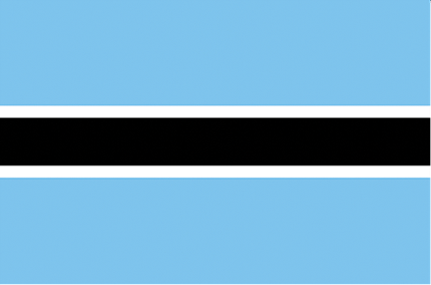
Botswana
Key facts:
POPULATION (2018 estimate): 2,304,238
AREA (UN 2006): 582,000 sq km
CAPITAL: Gaborone
CURRENCY: pula (BWP)
HEAD OF STATE AND GOVERNMENT: President Mokgweetsi Masisi
FORM OF GOVERNMENT: republic
PARLIAMENTARY SYSTEM: bicameral
STATE STRUCTURE: unitary
LANGUAGES: English, Setswana (official)
NATIONAL ELECTIONS: last: Oct 2019, turnout: 84.15%; next: Oct 2019
WOMEN IN PARLIAMENT (2019): 11.1%
LOCAL ELECTIONS: last: Oct 2019, turnout: 84.6%; next: Oct 2024
WOMEN COUNCILLORS (2019): 18.1%
LOCAL GOVERNMENT EXPENDITURE as a percentage of total government budget 2019/20: 10.1%
Summary
.jpg) Botswana is a democratic republic with a two-tier system of government: national government headed by the president and local government headed by a mayor in towns/cities and a council chairperson in rural districts. There is no constitutional provision for local government, and the main legislation is the Local Government Act 2012. The Ministry of Local Government and Rural Development is charged with providing policy direction and guidance. Local government comprises 16 administrative districts (ten rural and six urban). Under these, there are 23 sub-districts including four administrative authorities. There is also a traditional system of villages headed by a kgosi (chief) which works cooperatively with other district institutions. Following the 2019 local elections, 18.1% of councillors were women, and in 2018/19 local government budgeted expenditure was 13.7% of total government budgeted expenditure. Councils have legal powers to collect certain taxes, levies and fees, though up to 90% of their total recurrent revenue is provided by national government. Statutory council functions include provision of primary infrastructure, tertiary and access roads, health and sanitation, economic and physical development, collection and management of waste, and general maintenance of law and order.
Botswana is a democratic republic with a two-tier system of government: national government headed by the president and local government headed by a mayor in towns/cities and a council chairperson in rural districts. There is no constitutional provision for local government, and the main legislation is the Local Government Act 2012. The Ministry of Local Government and Rural Development is charged with providing policy direction and guidance. Local government comprises 16 administrative districts (ten rural and six urban). Under these, there are 23 sub-districts including four administrative authorities. There is also a traditional system of villages headed by a kgosi (chief) which works cooperatively with other district institutions. Following the 2019 local elections, 18.1% of councillors were women, and in 2018/19 local government budgeted expenditure was 13.7% of total government budgeted expenditure. Councils have legal powers to collect certain taxes, levies and fees, though up to 90% of their total recurrent revenue is provided by national government. Statutory council functions include provision of primary infrastructure, tertiary and access roads, health and sanitation, economic and physical development, collection and management of waste, and general maintenance of law and order.
The Botswana Association of Local Authorities (BALA) is a voluntary organisation to promote unity and cooperation between local authorities and work with governemnt on matters that affect tis members.
Read profile of the local government system in Botswana.
CLGF activities in Botswana
Botswana is one of the focus areas for the CLGF programme on Suppoting Local Governance and Local Economic Development. CLGF has signed a project agreement with partners in Botswana to support the development of a national decentralisation policy and LED framework and strategy.
CLGF is working with the Ministry of Local Goverment and Rural Development and the Botswana Local Government Association (BALA) and UNDP to enhance capacity at both central and local levels to foster inclusive economic growth and diverisfy the economy.
Four local authorities have been selected for local pilort projects to support the national initiatives: Chobe, Francistown, Kgalagadi and Sowa town. These will focus on:
- developing the capacities of local governemnt officials and councillors to plan and implement LED;
- preparing LED strategies, design and implementing pro-poor projects to improve local economies in the target authortiies;
- developing tools and systems to guide the planning and implementation of LED;
- setting up local institutional arrangements and aprtnerships for the coordination of LED planning and implementation;
- strengthening capacity in knowledge management, advocacy and communications, monitoring and evaluation, and reporting.
The terms of reference for the development of the decentralisation policy and implementation plan for Botswana can be found here:Towards a decentralisation policy for Botswana.
CLGF members in Botswana
- Botswana Association of Local Government Authorities
- Ministry of Local Government and Rural Development

.png)


.png "Angola")
.png "Malawi")