Upcoming: Caribbean Regional Meetin
The Commonwealth Local Government Forum (CLGF) - in collaboration with the Caribbean Community Climate Change Centre (CCCCC) - will host the Caribbean Regional Meeting on “Climate Resilient Urban Developm ...

The Commonwealth Local Government Forum (CLGF) recently participated in the Global Roundtable on the Future of Decentralisation and Multilevel Governance, held on 26–27 February 2026 at New York University’s Wagner Graduate School of Public Service.
Convened by the Local Public Sector Alliance (LPSA) in partnership with organisations including the Forum of Federations, NALAS, NYU Wagner, OECD, UNDP, the World Bank amoung others, the roundtable brought together policymakers, city leaders, researchers and international organisations to examine how decentralisation and multilevel governance systems must evolve in response to a rapidly changing global context.
Discussions explored how national and subnational governments can work more effectively together to deliver sustainable development outcomes in the face of rapid urbanisation, fiscal pressures and increasing climate risks.
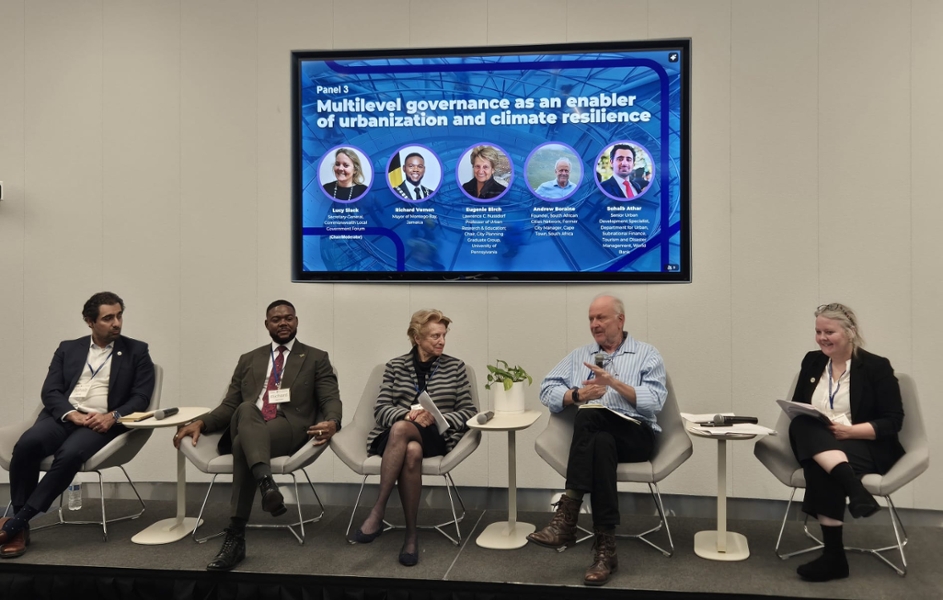
CLGF played a central role in the programme by designing and facilitating Panel 3, titled: “Multilevel Governance and Cities: Enabling Climate Resilience in Practice”. The session was facilitated by Lucy Slack, Secretary-General of CLGF, and brought together a diverse group of speakers reflecting city leadership, global policy perspectives and governance expertise.
Panelists included:
The session explored how multilevel governance systems shape urbanisation outcomes and cities’ ability to respond to climate pressures in practice, recognising that cities are increasingly at the frontline of both development opportunities and growing risks.
Rather than focusing solely on climate policy, the panel used climate resilience as a lens through which to examine how governance systems operate in reality, particularly where responsibilities, resources and incentives are not well aligned across levels of government.
Several important observations emerged from the discussion.
First, participants highlighted that the ability of cities to respond to urbanisation pressures and climate risks is strongly influenced by how authority, resources, and incentives are aligned across levels of government. While many countries have formal decentralisation frameworks, in practice responsibilities and financing mechanisms do not always match.
Second, the discussion underscored that urban finance constraints are often structural rather than technical. Rules governing borrowing, fiscal transfers, and revenue authority are frequently set at national or state levels, shaping what cities are realistically able to deliver.
Third, the panel noted that many climate resilience investments, such as flood protection, coastal infrastructure, and heat mitigation, are public goods. These investments are essential but often do not generate direct revenue streams, making it difficult for cities to rely solely on commercial finance.
Finally, participants emphasised that climate risks increasingly expose the gap between responsibility and resources at the local level. Cities are often expected to respond first when crises occur, yet the financing and institutional tools required to act effectively may sit elsewhere in the governance system.
Insights from the session will feed directly into CLGF’s wider work with the Commonwealth Sustainable Cities Initiative (CSCI) and its current project work under the Commonwealth Sustainable cities Coalition (CSCC), particularly through the Urban Finance Action Group.
The Action Group is examining how governance arrangements influence cities’ access to finance and what reforms may be required to enable more resilient and inclusive urban development across the Commonwealth.
The Roundtable discussion reinforced the importance of addressing the governance dimensions of urban finance, including fiscal frameworks, access to investment finance, and the alignment of responsibilities across levels of government.
CLGF will continue to work with partners to build on these insights and support member countries in strengthening multilevel governance systems that enable cities and local governments to deliver sustainable urbanisation and climate resilience in practice.
Back to News