The importance of connecting local
As the 30th anniversary year of the foundation of the Commonwealth Local Government Forum (CLGF) concludes, its work is more important than ever. The topics that repeatedly arise in Commonwealth meeti ...

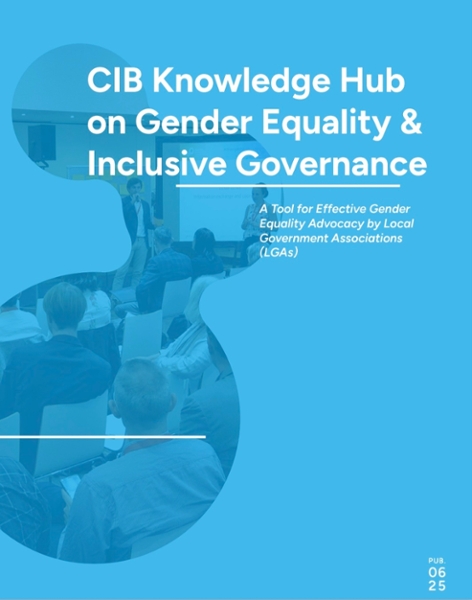
CLGF is pleased to introduce a new advocacy resource for gender equality in the form of a practical tool for local government associations. Local Government Associations (LGAs) across the Commonwealth play a critical role in shaping national policy, amplifying the collective voice of local authorities, and advancing inclusive and responsive governance. In recent years, many LGAs have also taken on an increasingly visible leadership role in promoting gender equality, both within local government institutions and in the communities they serve.
Against this backdrop, the Commonwealth Local Government Forum (CLGF) and the Commonwealth Women in Local Government Network (ComWLG) are pleased to highlight a newly released resource that will be of effective and practical value to our members: A Tool for Effective Gender Equality Advocacy by Local Government Associations, developed by the UCLG-CIB Knowledge Hub on Gender Equality and Inclusive Governance.
The tool aligns closely with the shared priorities of CLGF and ComWLG on women’s leadership, inclusive governance, and strengthening the institutional capacity of LGAs across the Commonwealth.
The advocacy tool was formally presented on 17 December 2025, at a session entitled “LGAs Leading the Way: Turning Gender Equality Advocacy into Action.” The session brought together LGAs, practitioners, and partners from different regions to reflect on how associations can move beyond commitment statements and translate gender equality advocacy into concrete policy influence.
The tool draws on consultations with LGAs already engaged in gender equality work and responds directly to the practical challenges associations face when advocating on issues that are often politically sensitive and deeply embedded in social norms.
For many LGAs, gender equality advocacy is among the most impactful, but also most complex, forms of policy engagement. Unlike traditional advocacy focused on finance, infrastructure, or decentralisation, gender equality advocacy often requires challenging entrenched systems, addressing power imbalances, and sustaining political will over time.
This tool recognises that reality. It positions gender equality advocacy not as an optional or “add-on” activity, but as a core function of effective LGAs committed to democratic, inclusive, and responsive local governance. It also reinforces the unique role LGAs play in bridging national commitments, such as SDG 5 and international gender equality frameworks, with the lived realities of local governments and women leaders.
The publication provides step-by-step, practical guidance structured around the full advocacy cycle. Rather than prescribing a single model, it offers adaptable approaches that LGAs can tailor to their political, institutional, and cultural contexts.
Key elements include:
1. Clarifying gender equality advocacy “asks”
The tool helps LGAs clearly define what change they are seeking, whether related to women’s representation, gender-responsive policies, addressing violence against women in politics, or integrating gender perspectives into broader local government reforms. It emphasises evidence-based advocacy and the importance of grounding policy asks in both data and lived experience.
2. Developing a strategic advocacy plan
LGAs are guided through analysing the political environment, identifying decision-makers and allies, setting realistic objectives, and crafting clear messages. Particular attention is paid to aligning advocacy with national priorities while maintaining a strong, principled gender equality focus.
3. Implementing advocacy actions
The tool outlines a range of advocacy techniques commonly used by LGAs, including structured engagement with central government, participation in formal consultation mechanisms, targeted campaigns, media engagement, and mobilisation of member local authorities. It also highlights the importance of storytelling and the strategic use of both women leaders and male champions.
4. Monitoring, learning, and adapting
Recognising advocacy as an ongoing process, the tool encourages LGAs to monitor progress, reflect on results, and adjust strategies over time. Simple performance monitoring approaches are proposed to support accountability and learning without creating undue administrative burden.
In addition, the final section curates a wide range of complementary tools, guides, and examples that LGAs can draw on to strengthen their advocacy work.
5. Strong alignment with CLGF and ComWLG priorities
The themes and approaches outlined in this tool strongly resonate with the work of CLGF and ComWLG, including:
For ComWLG members, in particular, the tool offers a practical framework to complement ongoing peer learning, mentoring, and leadership initiatives by strengthening the policy influence role of LGAs themselves.
CLGF encourages its members, and members of the ComWLG network, to explore this resource and consider how it can be adapted to national and regional contexts across the Commonwealth. Whether your association is at an early stage of engaging on gender equality, or already actively advocating for reform, the tool provides structured guidance that can enhance clarity, coherence, and impact.
Importantly, the tool is designed as a living resource. LGAs are encouraged to contribute their own examples, lessons, and advocacy experiences, helping to strengthen global peer learning and collective progress.
As CLGF continues its work to support inclusive, democratic, and resilient local governance, we welcome resources such as this to equip LGAs with practical tools to lead change, ensuring that gender equality is not only advocated for, but actively advanced and seen, throughout the Commonwealth.
Who is this tool most useful for
LGAs at different stages of engagement, from those beginning gender equality advocacy to those seeking to professionalise, structure, or scale existing efforts,
Back to News