Local elections in Fiji

For the first time since 2005, the Republic of Fiji is preparing for its return to the polls for municipal elections in September 2026. This marks a pivotal milestone in the nation’s commitment to decentr ...

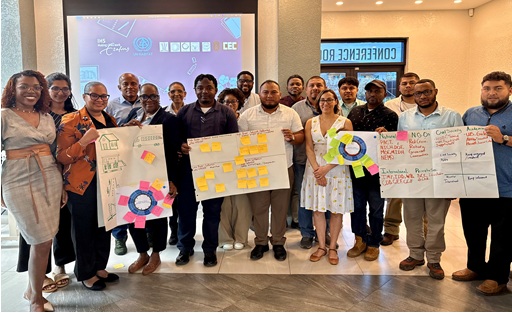
From 24 to 27 March 2026, CLGF’s Networks Manager, Janine Xavier-Cross, participated in a four-day workshop on Strengthening Capacity for Climate-Resilient Urban Planning in Belmopan, Belize, representing the partners of the Commonwealth Sustainable Cities Initiative (CSCI). The workshop formed part of a wider programme supporting capacity development for urban climate resilience in Belize and Zambia, and brought together local and national stakeholders to strengthen practical skills in governance, policy and resilience.
The workshop was designed in response to identified capacity gaps in areas including community engagement, strategic and visionary planning, data use for policy development, and adaptability and resilience in decision making. It marked an initial step in applying a competency-based approach to strengthen governance capacities and support more effective climate-resilient planning and decision making in Belize.
For CLGF members, the workshop offered a practical example of how capacity strengthening can be shaped around the real governance and planning challenges facing cities and towns. Rather than a generic training exercise, it was structured around Belize’s own institutional and planning context, with a strong emphasis on practical application and long-term capability.
In her opening remarks, Janine welcomed participants on behalf of the Commonwealth Local Government Forum and as part of the Commonwealth Sustainable Cities Initiative. She highlighted that sustainable urbanisation cannot be delivered by one institution, one profession or one level of government alone, and emphasised the importance of collaboration, shared learning and practical coordination.
Her participation reflected CLGF’s role within the wider CSCI partnership, which brings together Commonwealth organisations working across local government, planning, architecture, engineering and higher education to support countries in responding to the linked challenges of rapid urbanisation and climate change. CLGF was able to represent that wider partnership while also bringing a strong local government perspective into the workshop discussions.
The workshop brought together participants from local government, national ministries, academia and professional bodies. Organisations represented included Belize City Council, Belmopan City Council, the Ministry of Sustainable Development, Climate Change and Solid Waste Management, the Ministry of Natural Resources, Petroleum and Mining, NEMO, the University of Belize, Galen University, and professional associations representing architects, planners and engineers. Organising partners included the partners of the Commonwealth Sustainable Cities Initiative, IHS Erasmus University Rotterdam, UN-Habitat and other supporting institutions.
This broad participation reinforced one of the central messages of the training: that more resilient and inclusive urban development depends on stronger coordination across sectors, stronger institutions and professionals who are able to work across different areas of expertise.
The workshop was led by Dr Pamela Durán Díaz of the IHS, Institute for Housing and Urban Development Studies of Erasmus University Rotterdam, who served as the main facilitator. Janine Xavier-Cross contributed as co-facilitator, representing CLGF and the wider CSCI partnership.
Across the four days, participants engaged in a practical programme covering governance concepts and assessment frameworks, public policy and public interest, policy formulation, policy analysis and policy briefs, socio-spatial data analysis and visualisation, stakeholder mapping and engagement, corruption in urban planning, and resilience diagnostics and strategy development. Through discussions and applied exercises, participants explored how governance processes, institutional dynamics and stakeholder relationships influence the implementation of climate resilience policies in Belize.
For CLGF, the Belize workshop also demonstrated the value of the Commonwealth Sustainable Cities Initiative in practice. The CSCI was established through a partnership of Commonwealth organisations to help support more joined-up responses to rapid urbanisation and climate change.
The related Commonwealth Sustainable Cities Coalition (CSCC) project is focused on moving from commitment to implementation by addressing knowledge, skills and capacity gaps affecting how cities and towns are planned, financed and managed. Its priorities include knowledge exchange, research, practical action and targeted capacity strengthening. The Belize workshop therefore offered a useful example of how those wider ambitions can be translated into a concrete learning process with direct relevance for local government practitioners and institutions.
The wider programme aims to strengthen the technical and decision-making capacity of local governments, urban professionals and partners in urban resilience and climate adaptation, while improving the ability of institutions to integrate climate resilience practices and policy frameworks into urban planning, policies and programmes. The Belize workshop was one practical contribution to that effort.
For CLGF members, the experience in Belize underlines the importance of investing in the skills, systems and partnerships needed to manage urban growth in more resilient, inclusive and effective ways.
Back to News