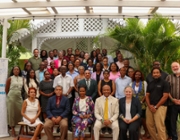
CLGF at the Pre-COP 31 in Fiji

The Pre-COP 31, 5-8 October, is being hosted by the Government of Fiji and it will include a Leaders Meeting which will take place in Tuvalu. The Pre-COP is the final major diplomatic moment before COP31 and wi ...

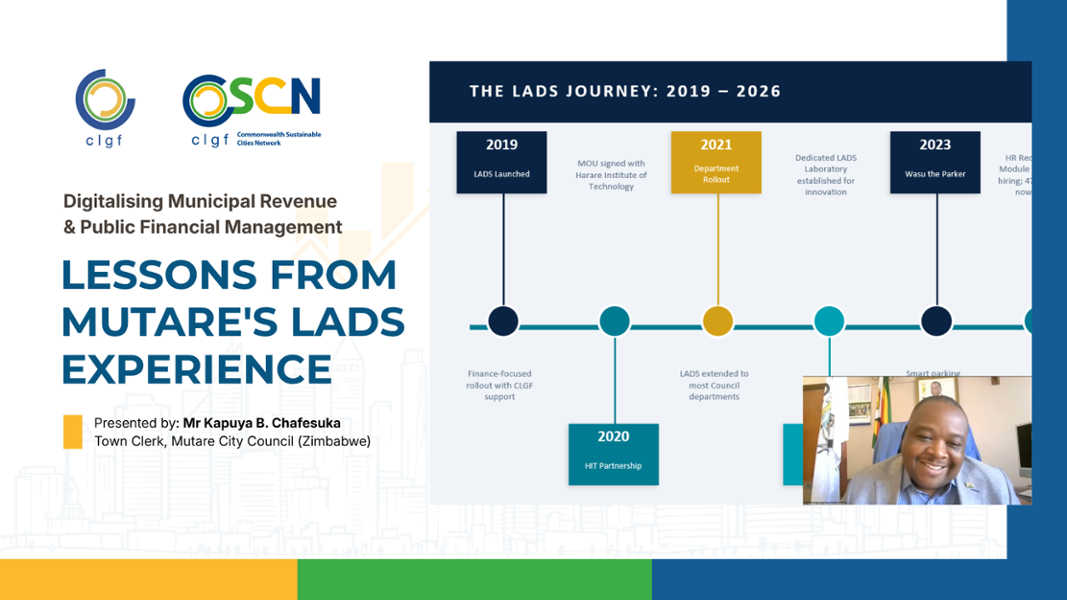
Last Thursday, CLGF - through the Commonwealth Sustainable Cities Network (CSCN), brought together local government leaders, practitioners and partners from across Africa and the Commonwealth for a Peer Learning Clinic exploring how digitalisation can strengthen municipal revenue administration and public financial management.
The online session, Digitalising Municipal Revenue and Public Financial Management: Lessons from Mutare's LADS Experience, attracted more than 100 registrations, with 61 participants joining the live event from local authorities, local government associations, ministries, development partners and research institutions representing countries including Zimbabwe, Botswana, Namibia, Uganda, Zambia, Rwanda, Cameroon, Nigeria, Sierra Leone, Togo and South Africa.
The webinar forms part of CLGF's CSCN Pilot on Digitalisation for Municipal Revenue Administration and Public Financial Management in Southern Africa, which promotes peer learning and practical exchange between local governments seeking to strengthen financial sustainability through digital transformation.
Opening the session, Janine Xavier-Cross, Networks Manager at CLGF, welcomed participants and emphasised that the clinic was designed as a practical exchange between local governments.
Rather than presenting a model to be replicated, the session provided an opportunity for a city that has successfully implemented digital reforms to share its journey openly - including the challenges encountered, the lessons learned and the practical approaches that other councils may wish to adapt within their own contexts.
Setting the scene, Leopold Bhoroma, CLGF Project Manager (Zimbabwe), reminded participants that digitalisation is increasingly becoming a strategic necessity for local government.
"Digitalisation is no longer a choice for local authorities - it is essential for financial sustainability, accountability and improved service delivery."
The centrepiece of the clinic was a presentation by Mr Kapuya Blessing Chafesuka, Town Clerk of Mutare City Council, who shared the council's experience in developing and implementing the Local Authorities Digital System (LADS).
Beginning in 2019 with a single revenue management module developed through a partnership with CLGF and the Harare Institute of Technology, LADS has evolved into a locally designed platform comprising 47 operational modules, supporting revenue administration, procurement, business licensing, stores management, asset management, human resources, internal communications and wider municipal operations. The council's long-term ambition is to develop LADS into a fully integrated Enterprise Resource Planning (ERP) system.
Participants heard how digitalisation enabled Mutare to address longstanding governance and financial management challenges.
Before the introduction of LADS, the council faced low revenue collection, widespread use of fake receipts, missing financial records, weak procurement controls, land management irregularities, salary arrears and recurring audit findings.
By strengthening revenue administration and introducing digital financial controls, Mutare increased overall revenue collection efficiency from 33 per cent in 2019 to an average of 65 per cent in 2026, with some months reaching 80 per cent. Digital billing, automated debtor management and real-time reporting have significantly reduced revenue leakages while improving financial oversight.
The presentation also demonstrated how digitalisation strengthened internal controls through electronic procurement approvals, budget monitoring, fuel management, asset registers and stores management, contributing to stronger financial discipline and improved accountability.
Mutare also shared how digitalisation has transformed governance and citizen engagement.
Audit management findings have reduced significantly, financial statements are now submitted within statutory deadlines, and digitised records have improved transparency while reducing opportunities for fraud and document loss.
Digital engagement has also changed the council's relationship with residents. Through a WhatsApp chatbot and online consultation platform, participation in annual budget consultations increased from fewer than 300 residents to more than 20,000 participants, helping strengthen public confidence in the budget process and improve communication between the council and citizens.
The webinar highlighted the direct relationship between stronger municipal finances and improved service delivery.
Improved own-source revenue has enabled Mutare to invest in expanded refuse collection services, improved water supply, additional ambulances and fire appliances, new schools and clinics, upgraded markets for informal traders and the rehabilitation of community recreational facilities.
Participants noted that the experience demonstrated how improvements in municipal revenue administration can translate into tangible benefits for local communities.
A recurring theme throughout both the presentation and discussion was that successful digital transformation depends as much on leadership and organisational culture as it does on technology.
Mutare highlighted the importance of committed leadership, departmental champions, staff training, strong governance arrangements and a willingness to manage organisational change. Participants also discussed practical approaches to overcoming resistance, prioritising investment where resources are limited and identifying the "tipping point" where digital intervention can generate the greatest organisational impact.
The webinar reinforced the value of peer learning as a practical mechanism for strengthening local government performance across the Commonwealth.
The insights generated during the session will inform the next phase of CLGF's CSCN Pilot on Digitalisation for Municipal Revenue Administration and Public Financial Management, supporting continued city-to-city learning, practical exchange and collaboration among participating councils.
Watch the webinar recording here: https://youtu.be/TzBZERmaKu8
The discussion also highlighted growing interest in strengthening own-source revenue mobilisation, complementing CLGF's recently launched CSCN Urban Finance resource hub, which provides practical recommendations, case studies and tools to support local governments in strengthening municipal finance.
Explore the CSCN Urban Finance resources: https://www.clgf.org.uk/what-we-do/cscn-urban-finance/
Back to News