Democracy is built close to home: How local government safeguards democracy
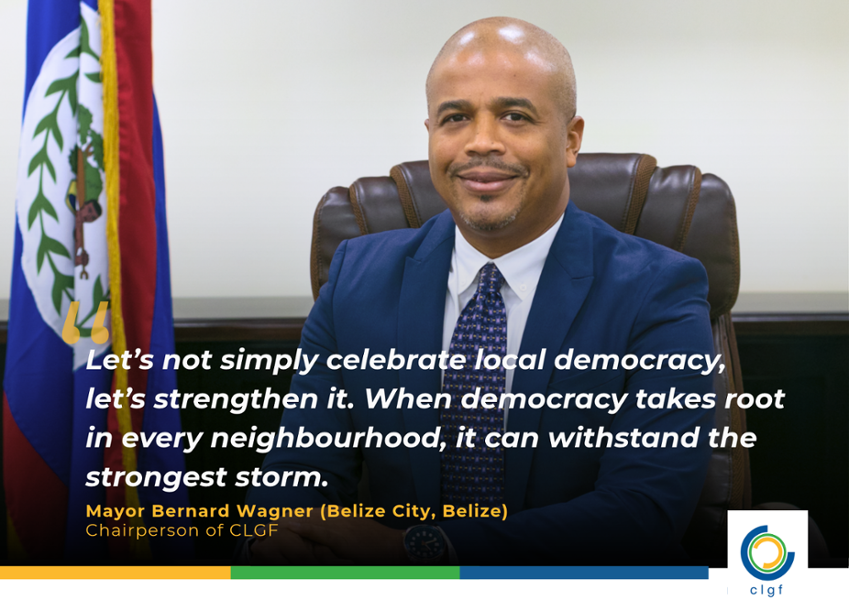
Mayor Bernard Wagner (Belize City, Belize), Chair, Commonwealth Local Government Forum (CLGF). Tuesday, 20 October 2026. Belize City, Belize.
Democracy is often discussed through elections, national institutions and the laws that govern a country. Those foundations are essential. But on the ground, residents experience democracy when they can connect with their elected officials; when complaints about road conditions lead to improvements; when public services respond fairly to residents’ needs; and when information is accessible and, crucially, flows both ways.
Those everyday experiences matter because democratic backsliding does not always begin with a sudden rupture. It can happen gradually as public trust declines, as people feel excluded from decisions or as public institutions become less accountable. When residents conclude that their voices don't matter, the space between citizens and government widens, and democracy becomes more vulnerable.
That is why local government matters. City councils are often the public institutions closest to residents. We hear concerns from neighbourhoods. We see how national decisions affect people on the ground, and we have a responsibility to show what action follows. Responsive services alone cannot protect democracy. But when residents can hold their representatives to account, democracy becomes real in their communities.
As Mayor, I have seen how nurturing public participation can give people a stronger connection to public life. Young people should not have to wait until adulthood to understand how decisions are made or to contribute their ideas. The Belize City Council’s Youth Shadow Council Program and Child Advisory Body give young people valuable opportunities to observe and engage with local leadership, and to contribute to policy development and implementation. Similarly, across the Commonwealth, initiatives like CLGF's Women in Local Government Network are supporting women in political leadership.
But local democracy can't happen in a vacuum. Democratic resilience requires constant communication, policy alignment and best-practice exchanges between national and local government, and across countries and regions. Networks like the Commonwealth Parliamentary Association (CPA) and CLGF are vital in bridging this gap, ensuring that high-level policies are practical to all levels of government, and truly serve their citizens. Initiatives like the CPA’s networks for women Parliamentarians, Parliamentarians with Disabilities and young Parliamentarians ensure that inclusive governance doesn't stop at the local level.
These initiatives are not a substitute for wider political participation. They are a way to help make participation more accessible and familiar. When young people, women or communities that feel marginalised from local or national governance can see how their ideas connect to real decisions, they are better positioned to become informed, confident citizens, and to expect accountability from those who serve them.
The Commonwealth has long recognised the connection between local governance and democratic resilience. The Aberdeen Agenda sets out principles for strong local democracy and good governance, including participation, transparency and accountability. The Commonwealth Charter recognises representative local government as an essential element of democratic governance. The Nadi Declaration on Democratic Resilience and Participation reinforces the importance of rights, the rule of law and people’s involvement in decisions that affect their lives. Local government is indispensable to putting these commitments into practice.
But commitments must be matched by the means to act. Local authorities need clear responsibilities, capable institutions, adequate resources and empowered leadership. While national or federal Parliaments provide the crucial legislative frameworks, oversight, rule of law and international coordination, local governments directly shape the public's daily experience of democracy. The two spheres must work together; Parliament creates a mandate for change, and local government ensures that those most affected by a policy have the most say in its implementation.
As Commonwealth leaders gather in Antigua for the Commonwealth Heads of Government Meeting 2026, I urge them to reaffirm local democracy as a safeguard against democratic erosion. Support decentralisation, invest in local capacity and create more opportunities for governments to learn from one another. The Commonwealth Local Government Forum and Commonwealth Parliamentary Association can help connect local experience with national policy and shared Commonwealth commitments. These networks can build on the work already underway.
My call is direct: let’s not simply celebrate local democracy, let’s strengthen it. Give local governments the authority, support and resources to serve their communities, and make participation count in practice. When democracy takes root in every neighbourhood, it can withstand the strongest storm.
Back to News