From Pacific voices to local action: CLGF champions local government leadership at Pre-COP31
The Pre-COP31 stakeholder programme in Nadi, Fiji (5-8 October 2026) placed Pacific priorities at the centre of global climate discussions. Set in a region facing profound climate risks, the meeting provided an opportunity to connect international commitments with the lived experiences of island communities. Through Vale ni Vanua – The Knowledge Exchange, traditional and community knowledge met science and policy frameworks, underscoring the importance of locally-informed solutions ahead of COP31 in Antalya, Türkiye.
CLGF contributed to this dialogue through two complementary sessions, helping make the case that municipal and provincial governments must be recognised not only as implementers of national policies, but as partners in shaping climate priorities, evidence and investment.
Making NDC implementation measurable
On 6 October, CLGF partnered with the Asia LEDS Partnership - hosted by ICLEI South Asia, in organising the session “Data-driven NDC Implementation in Pacific Nations”. Bringing together representatives from Kiribati, Fiji, Vanuatu and UN-Habitat, the session examined how greenhouse gas inventories, measurement, reporting and verification (MRV) systems and digital tools can strengthen the implementation of Nationally Determined Contributions (NDCs).

Kiribati’s newly developed national greenhouse gas inventory tool provided a practical example of how Pacific countries are strengthening their climate information systems. However, reliable national reporting also depends on local information about waste management, land use, infrastructure and essential services.
Devo Wari, representing Vanuatu’s Department of Local Authorities, emphasised the need for stronger municipal and provincial capacity, standardised reporting and coordination with national institutions. She also acknowledged CLGF’s on-going support for Vanuatu’s stronger local government capacity and decentralised governance.
In his closing remarks, CLGF Associate Shailendra Prasad reinforced three priorities: equipping councils to collect useful data, establishing effective national–local information sharing, and integrating local priorities into national climate planning and reporting.
Building partnerships for resilience
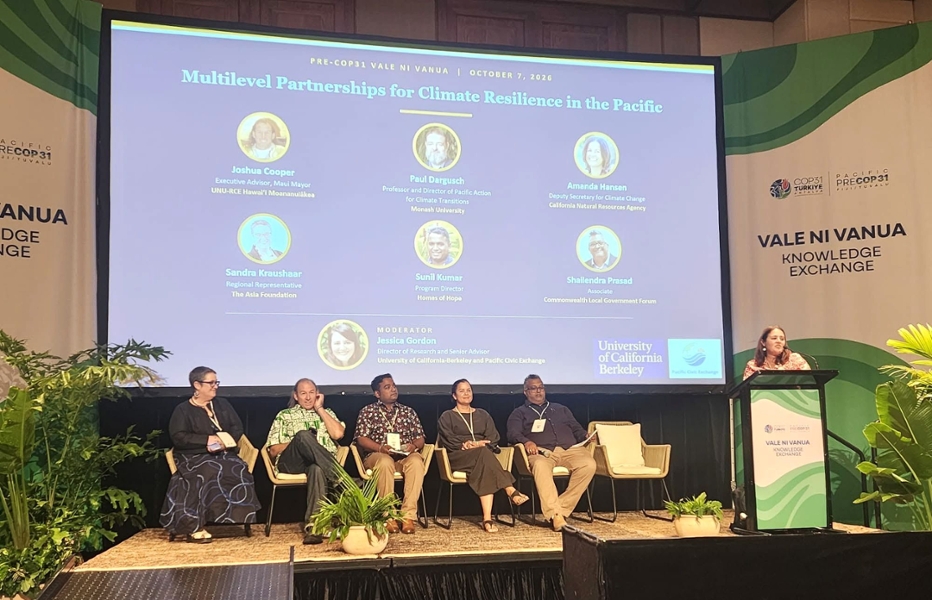
The following day, Shailendra joined the panel “Multilevel Partnerships for Climate Resilience in the Pacific”, organised by Pacific Civic Exchange and the University of California, Berkeley. The panel connected perspectives from the Pacific and beyond, including speakers associated with California, Hawai‘i, The Asia Foundation, Homes of Hope and Monash University.
The discussion explored how stronger multi-level cooperation and across the Pacific can turn climate commitments into practical measures that protect communities. Particularly, Shailendra highlighted key challenges councils face:
It was concluded that effective climate partnerships must go beyond short-term projects to strengthen local institutions, build lasting capacity, improve access to finance and usable climate information, and support regional peer learning.
A shared agenda for COP31
Together, the two sessions pointed to four interdependent priorities.
Better data can support credible NDC reporting, but it has limited value if councils lack the resources or authority to act on what it reveals. Similarly, resilience investment is more effective when local experience informs decisions from the outset.
Looking forward to the upcoming COP31, CLGF calls on governments and development partners to engage local authorities in climate planning, reporting and financing arrangements. Pacific climate resilience will depend on moving beyond consultation towards genuine partnership, where national ambition is matched by empowered local institutions and measurable action in communities.
Back to News