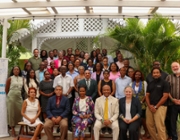
CLGF at the Pre-COP 31 in Fiji

The Pre-COP 31, 5-8 October, is being hosted by the Government of Fiji and it will include a Leaders Meeting which will take place in Tuvalu. The Pre-COP is the final major diplomatic moment before COP31 and wi ...

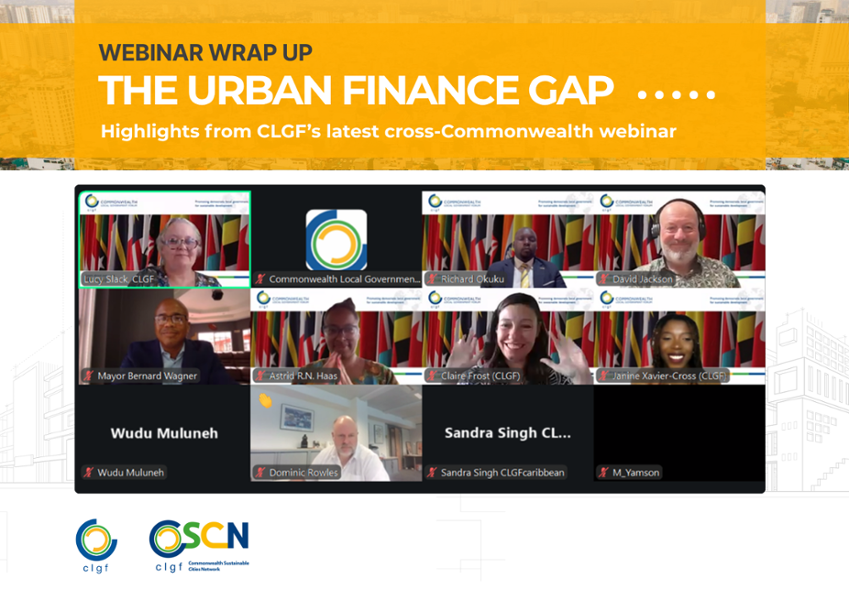
On 5 August 2026, the Commonwealth Local Government Forum (CLGF) brought together local government leaders, practitioners, researchers and partners for a cross-Commonwealth webinar exploring practical pathways to strengthen local government finance.
The online session, The Urban Finance Gap: Practical Pathways for Local Government Finance Across the Commonwealth, attracted 184 registrations from 39 countries, with 117 unique participants joining live on Zoom. They represented local governments, local government associations, national ministries, universities and training institutions, civil society, development agencies and other partners across Africa, Asia, the Caribbean and Americas, Europe, the Pacific and the Middle East.
The webinar introduced a major research paper developed through the Urban Finance Action Group (UFAG), which was established under the Commonwealth Sustainable Cities Coalition (CSCC), within the wider Commonwealth Sustainable Cities Initiative (CSCI). The research was funded by the UK Foreign, Commonwealth & Development Office (FCDO). CLGF is sharing the outputs with members and partners through the Commonwealth Sustainable Cities Network (CSCN).
Janine Xavier-Cross, CLGF Networks Manager, explained that UFAG members tested the evidence, challenged assumptions, contributed examples and refined the recommendations. She presented the paper, five recommendations, case studies and supporting resources as a connected package for policy dialogue and advocacy.
Opening the webinar, Mayor Bernard Wagner, Chairperson of CLGF and Mayor of Belize City, described the finance gap as the distance between local responsibilities and the means available to meet them. Residents experience government locally - through streets, drainage, waste collection, public safety and resilience, but many of the decisions that shape local fiscal space, borrowing and access to climate finance are taken nationally or internationally.
Lucy Slack, Secretary-General of CLGF, emphasised that local capacity matters but sits within a wider system of national fiscal frameworks, intergovernmental transfers, borrowing rules, financial intermediaries, market conditions and climate-finance access. The purpose of the webinar was therefore not only to present new research, but to connect the evidence to practical use by local governments, associations and partners.
Presenting the paper, author and UFAG research expert Astrid R.N. Haas set out evidence from 18 Commonwealth countries across six dimensions of urban finance: own-source revenue, intergovernmental fiscal transfers, municipal borrowing, market conditions and creditworthiness, access to climate finance, and equity across the urban system.
.png)
Five recurring findings emerged from the analysis:
The paper also examines experiences from Belize City, Kerala and Kigali, together with five financial intermediaries from across the Commonwealth. The examples are intended to identify principles that can be adapted to different contexts, rather than models to be copied without regard to local institutions and political economy.
Responding from a mayoral perspective, Mayor Wagner highlighted Belize’s 2024 Municipal Securities Act and municipal bond experience as evidence that cities can engage national institutions and domestic investors to create new financing pathways. He also stressed that capital investment must provide for operation and maintenance, drawing on Belize City’s experience with flood-management infrastructure.
“A project succeeds not when it is completed, but when it continues to work for the community” - Mayor Bernard Wagner, Chairperson of CLGF and Mayor of Belize City
Richard Okuku, Secretary General of the Uganda Local Governments Association, explained how the research and Belize experience are informing Uganda’s work on pooled finance, unfunded mandates and a “local government financing dividend”. He called for practical case studies and stronger peer learning. Both he and David Jackson stressed that urban finance should be seen not as a drain on the public purse, but as an investment in a more resilient and sustainable future.
David Jackson, Non-Resident Fellow at the NYU Center on International Cooperation, highlighted the role of subnational development banks, municipal funds, pooled mechanisms and domestic capital markets in providing longer-term local-currency finance. He noted that public infrastructure may generate greater social value than financial return, while investment in local services and climate adaptation can reduce risk, strengthen local economies and build long-term public value.
The discussion reflected the practical concerns raised in advance by registrants. Participants asked how historically underfinanced cities can attract investment; how local government associations can access municipal bonds and climate-finance mechanisms; how inflation and corruption affect municipal finance; and how the findings can influence national policy and be adapted to different local realities.
Contributions from Uganda, the Solomon Islands, Ghana, Guyana, Nigeria, Sri Lanka and other contexts reinforced two themes: reform must address the political economy of national-local relations, and local examples are most useful when they are treated as evidence for adaptation rather than universal best practice.
.png)
Claire Frost, Head of Programmes at CLGF, closed the substantive discussion by presenting five recommendations developed through the UFAG process:
The recommendations are deliberately interconnected. Fiscal space must be matched by capable and accountable local systems; stronger systems need viable finance pathways; climate resources need channels that reach local priorities; and infrastructure is not sustainable if financing stops at construction.
The webinar marks the next stage in taking the UFAG work to the wider CLGF membership. CLGF will continue the discussion through further thematic webinars, practical member resources, the CLGF Finance Task Force and wider Commonwealth policy opportunities. Members and partners are also invited to share relevant examples and innovations for inclusion in the growing urban finance resource bank.
As Lucy Slack noted in closing, the central message is straightforward: if local governments are expected to deliver, they must have the fiscal space, systems and practical pathways to do so - fairly, sustainably and effectively.
Watch the webinar recording: CSCN Webinar: The Urban Finance Gap
Explore the resources: CSCN urban finance resource hub
Read the paper: The Urban Finance Gap: Systems, Constraints, and Reform Pathways across the Commonwealth
Back to News